
Photographs from the anatomical collection of
Museum Bleulandinum
Anatomisch Museum, Functionele Anatomie,
Universiteit Utrecht
February 2008

No. 249
Museum Bleulandinum is organized around the collection of Jan Bleuland (1756-1838), a medical doctor and professor of anatomy and obstetrics at Utrecht University. Prof. Dr. Bleuland was well known for the high quality of his anatomical models, which he prepared himself using highly innovative techniques. Among Bleuland's greatest achievements were preparations displaying vascular systems, in which he made even the tiniest blood vessels visible by injecting concoctions of dye or mercury. Another of Bleuland's specialties was in finding methods which accurately preserved the true colors and textures of organs, which in less careful hands might become bleached and shrunken.
In addition to creating his own preparations, Bleuland actively acquired examples of earlier masters, most notably specimens crafted by Amsterdam anatomist Frederik Ruysch (1638-1731), whose elaborate and often allegorical presentations disguised the voorsnijder's cuts with items of jewelry and clothing. One fine example to be found on display in the museum is Ruysch's “Kinderhoofdje met Turkse muts” (Child's head with Turkish cap).
In 1815, Willem I of the Netherlands (1772-1843) purchased Bleuland's collection and donated it to Utrecht University, which took ownership upon Bleuland's death in 1838. Clearly enthusiastic about the benefit this collection would have in the education of future doctors, Willem issued a royal decree the following year that all Dutch universities install such cabinets, which was surely a boon to education in general and anatomists like Bleuland in particular.
Today, the Museum Bleulandinum includes the original 475 objects purchased from Bleuland (Collectie Bleuland), anatomical waxes by Petrus Koning (1787-1834), a library of important historical medical texts, and several other anatomy and embryology collections — including examples of modern plastination. The museum now resides within Utrecht's Universitair Medisch Centrum.
Special thanks to Peter Heller, who allowed me access to the collection and spent a great deal of time talking about Bleuland's methods and introducing me to his favorite specimens; Reina de Raat, who gave me a wonderful ‘behind the scenes’ tour of the Universiteitsmuseum storage depot; Willem Mulder, for generously acting as my Utrecht tour guide and imparting some of his expansive knowledge in this field; and Rosamond Purcell for her advice and introductions.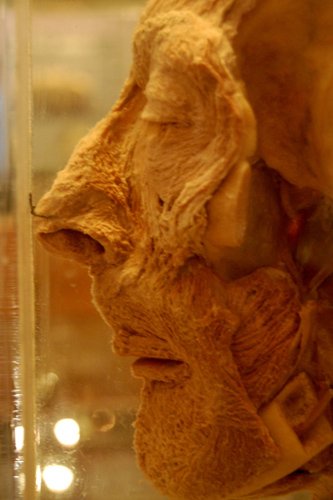
Profile

An image of a clarified human hand showing bones and fingers.

A photograph of an ancephalic skeleton displayed in a glass case.

An abnormal human fetal specimen submerged in a glass container.

Black and white photo of an anatomical specimen with distorted face with large eyes and open mouth, resembling a surreal or altered image.

Duet

A preseved speciman of a partially dissected specimen with a big smile, mouth wide open, in black and white.

Close-up of an abnormal human fetus preseved in a jar with its arms with tucked under the head, in black and white.

Orang-utan foetus
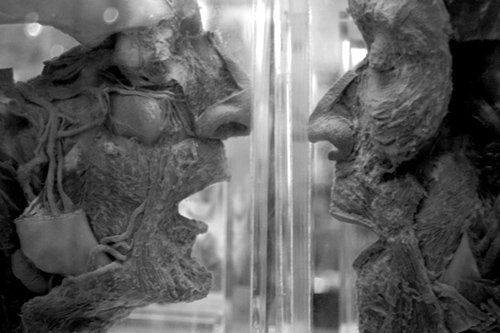
Argument

Two skeletal hands submerged in a glass container, with reflections visible on the fluid's surface.

Close-up of an abnormal human fetus with closed eyes and lips, with an object resembling a nose on the forehead.

No. 22 Sympodie

Glass vials containing small bones suspended inside, displayed on a reflective surface.
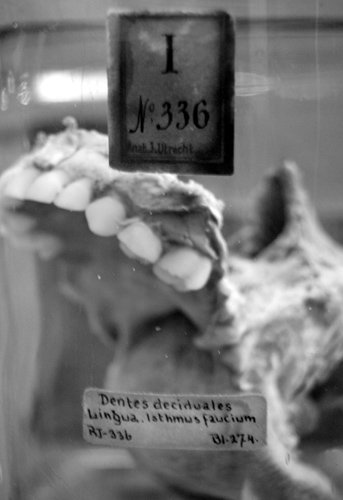
No. 336 (dentes deciduales)

No. 304

A preserved specimen of a hand with lace around the wrist in a glass display case, labeled with scientific information.

Close-up of a preserved abnormal fetus with tightly closed eyes, resting hand near face, in black and white.

An anatomical wax sculture depicting a head with an open mouth and visible teeth, placed upside down, with a background that appears to be a dissected biological specimen.

Two preserved embryo specimens in glass display boxes, labeled for early developmental stages with ages listed in months, used for scientific or educational purposes.

Reaching

A baby in a glass jar, viewed from below, with blurred lights in the background.

Sirenomelia

A fetus inside a glass container, resembling a liquefied or preserved state.

Two glass bottles on a reflective surface with unclear labels, containing preserved specimens of human skins with tattooed images, both capped and in black and white.

Kinderhoofdje met Turkse muts